Figurative Art Genius, Cornelius Annor and 'A Family Affair': review & interview.
- Lourdes Alexandra Oppong

- Mar 12, 2021
- 5 min read
Updated: May 24, 2021
- ‘And what was the reception like when your residency began in the gallery?’
- ‘Wow!’.
There is a slight pause. He takes a deep breath and then breaks into a series of chuckles, laced with overwhelming gratitude and disbelief.
- ‘I had so many DMs on my Instagram page- the feedback has been really really good!’
(Saturday Night, 2020)

Splurged across the walls of Accra’s vibrant contemporary art hub, Gallery 1957, is a colourful combination of Cornelius Annor’s experiences and culturally infused imagination. Four months of endless trips to and fro the gallery's studio in Nasser Avenue Ridge and a desire to further his extensive knowledge on and fascination with portraiture has birthed a stunning collection of pieces that host animated and exuberant figures nestling within a nostalgic haven of Ghanaian domestic leisure and gatherings; they cuddle up to watch the GTV evening news, break into conversation over half-empty Club beer bottles at chop-bars or gather on the veranda to share bowls of ampesie and a laugh. However, this isn’t just any wicked art- Annor’s collection comprises intimate screenshots of pivotal yet very human moments in his life. And it all begins with a little romance.
- ‘The inspiration behind A Family Affair all started when I decided to get married’.
(Anigye Da, 2020)
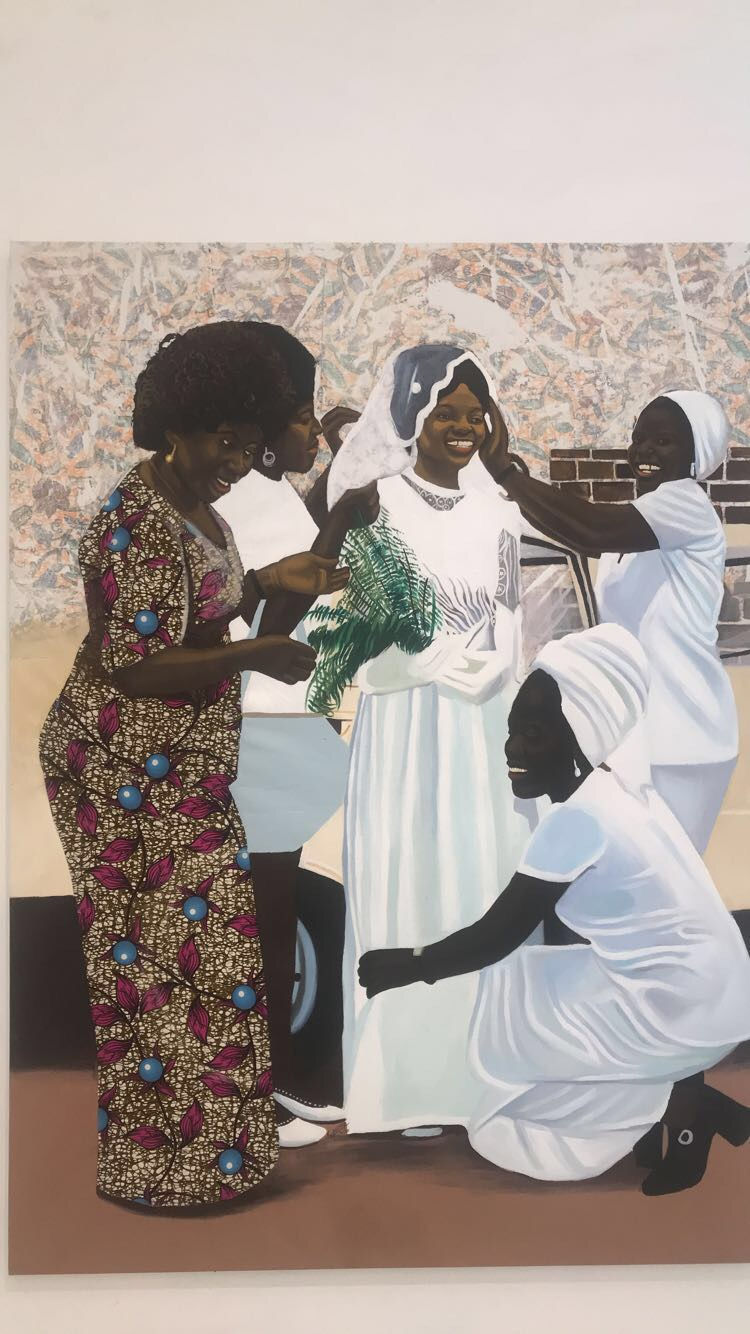
In a bid to fulfil cultural obligations attached to traditional Ghanaian marital rites, Annor took a trip to the Eastern region to reconnect with the paternal side of his family from which he had been estranged from since his father’s passing. The artist was treated to a delightful reintroduction to his family and found himself using the revitalising experience and his observations as a guide to reflect what he refers to as 'the family of intimacy' and 'the family of distance' across time, in his work.
- ‘I wanted to be able to collide two times (with my extended family) together-both the old era and the new era together. And also, to be able to highlight and merge times and locations.’
(Naming Ceremony, 2020)

Like any contemporary West African artist, the Ghanatta College of Art Design alumnus does not shy away from the opportunity to enrich his work with elements of his culture. The facially expressive figures in the collection are adorned in African-printed clothes, through the artist’s innovative skilfulness in fabric transfer. Annor’s dedication to precision is admirable- the fabric on the painted bodies of his figures, courtesy of textile powerhouses GTP, Vlisco and Hitarget are cut, folded or scrunched up in a manner that mimics being physically worn. And what’s more- the fabrics are owned by the very people who inspired the artist!
- ‘All the fabric that I used (in the pieces) are from my family archive- my mum, my dad’s side and also my aunt’s. I wanted my family to be part of the work that I was producing’.
Annor’s passionate reinvention of his familial reunions are a call to celebrate the one thing that drips from the hearts of many Ghanaians- community. Ironically, a refreshing one led by Annor himself, aided in the materialisation of his stellar exhibition.
- ‘I have a team. I have about five guys that helped me produce most of the work in the exhibition. I actually train them in my studio- they are also young artists like myself- and I’ve trained them for about three to four years now’.
Through Annor’s traineeship, these young art-heads are encouraged to create and occupy their own spaces within the art realm, as their responsibilities on Annor’s projects are tailored according to their individual abilities and talents.
- ‘When they even do stuff, they do it like the way I want my stuff to be like but everyone has their own part they play in my work’.
(Anuanom, 2020)

Although the full-time artist is comfortable working in solitude and thus refers to himself as ‘usually independent’, his love for art has unlocked doors to meaningful friendships with his peers, such as recent Kim Jones-colloborator Amoako Boafo, and a network of impressive individuals who speak the same creative tongue.
- ‘Apart from the people you train, do you surround yourself with others that make art too?’
- ‘Yeah, I’m also in a group called Pito’.
- ‘Oh- that’s interesting! Does the name of the group have any particular meaning?’
- ‘Yeah. It means ‘painting in the opening’. '
The sensational thirty-member collective grants a variety of artists and art enthusiasts access to one another to regularly discuss personal projects, possible collaborations and organise meet-ups. Pito’s existence is comforting especially as its members live in a country that does not necessarily cater to the needs of its promising art industry.
- ‘What do you think Ghana’s art space needs right now?’
- ‘I think the government needs to get involved. I think the government has to produce more national galleries, more national museums. Yeah. And more spaces for artists to work from’
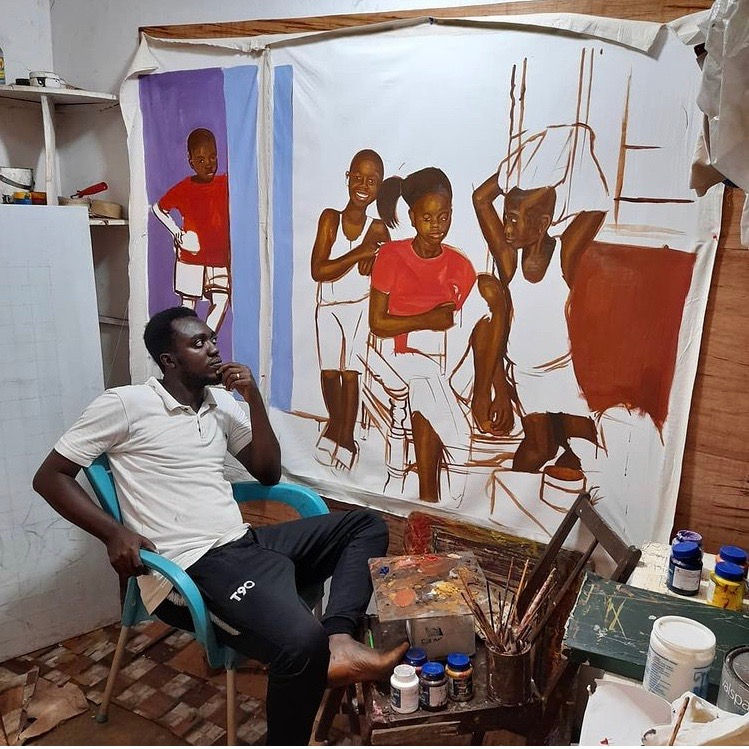
(Cornelius Annor working in his studio, 2020)
Ghanaian creative craftsmanship often comes along with a string of obstacles in the form of lack of funding, support and underpayment by the very institutions that could and should propel its progression. Due to their potential being overlooked and dismissed, many young creatives cannot afford committing to their craft full-time and surrender to the alternative of falling into traditional (and unsurprisingly, socially celebrated and approved) occupations to survive. This does not apply to Annor; the artsy unicorn is fortunate enough to spend his 9-5 schedule behind canvases in his own studio in Kokomlemle, monetising each brush stroke. However, he is not blind to the daunting climate discussed above and after eleven years of professionally exploring his passion, he has come to a conclusion:
- ‘This thing belongs to anything- if you have a (creative) talent and you want to grow up with it, it is not easy to survive (in Ghana). Especially, when it comes to the painting aspect, you’ll be needing a lot of materials to work with and even space. I think it’s not easy to come up with all those things. But with time…you can do it. With me, when I was growing up, I just had to be determined’
(Ampesie, 2020)

Interestingly, the global art scene’s reception towards Ghanaian and West African art in general, is quite the opposite. International collectors, investors and reputable auction houses from more established economies are aggressively plunging into the African art market, sweeping away contemporary authentic pieces and demanding for more. The iconic and late Nigerian modernist Ben Enwowu's Christine, for example, was sold for £1.1 million in London's esteemed Sotheby's.
Growing up with a sculptor as a father whilst trekking across both formal and informal art educational landscapes, it is quite clear that this remarkable artist has always and continues to live, breathe and eat art. However, it is worth noting that like you and I, he chooses to kick back at times and indulge in activities that do not include a palette.
- 'I like watching movies and football if I am not painting'.
- 'What about music? What are your three favourite songs at the moment?'
- 'Three favourite songs? At the moment? This guy's album- Akan!'
- 'Pure Akan? 'Onipa'?'
- 'Yes- Pure Akan! 'Onipa Akoma'! I love all the songs on that album. And Davido's album too. I love 'F.E.M'!'
(Cornelius Annor working on Efie Mu Asem, 2020)

(Completed work- Efie Mu Asem, 2020)
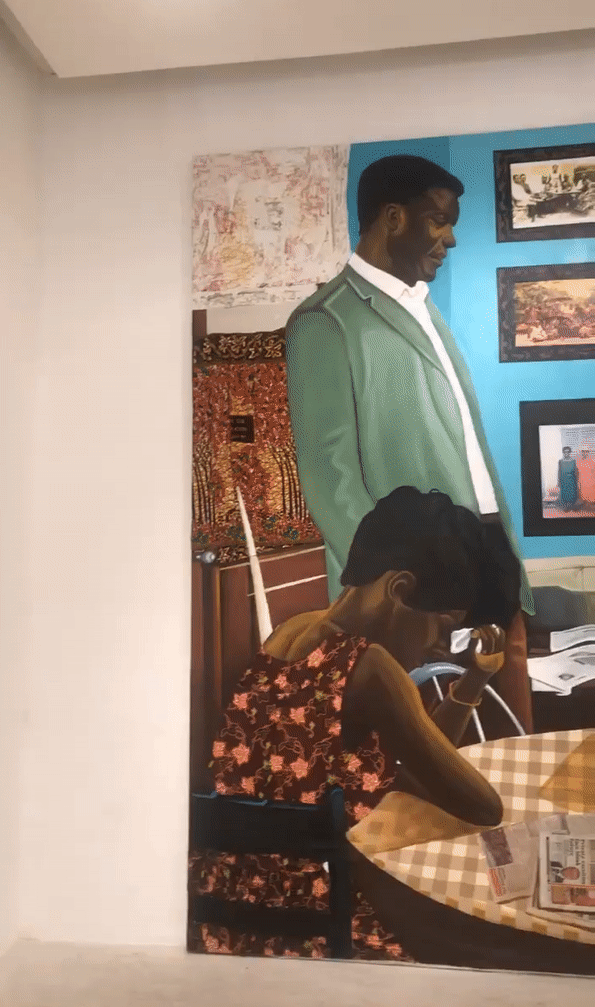
Recently, a number of contemporary art galleries have sprung up on Accra soil and one can only look forward to the increased visibility bound to be provided to local artists. Perhaps the world should gear itself up for more Cornelius Annors, scattering parts of their crisp identities and experiences all over blank sheets of paper to make painfully relatable and alluring art.
For more information on A Family Affair, visit Gallery 1957's website.

(Conversing, 2020)

(Before Bedtime Stories, 2020)

(Black doll, 2020)
Comments